What Elon Musk, Bill Clinton, and Other Leaders Discussed at the Milken Institute Conference
Market Update: Check out the highlights discussed in the monthly live session where Richard Ditizio, CEO of the Milken Institute, shared insights from the global event
By Itaú Private Bank
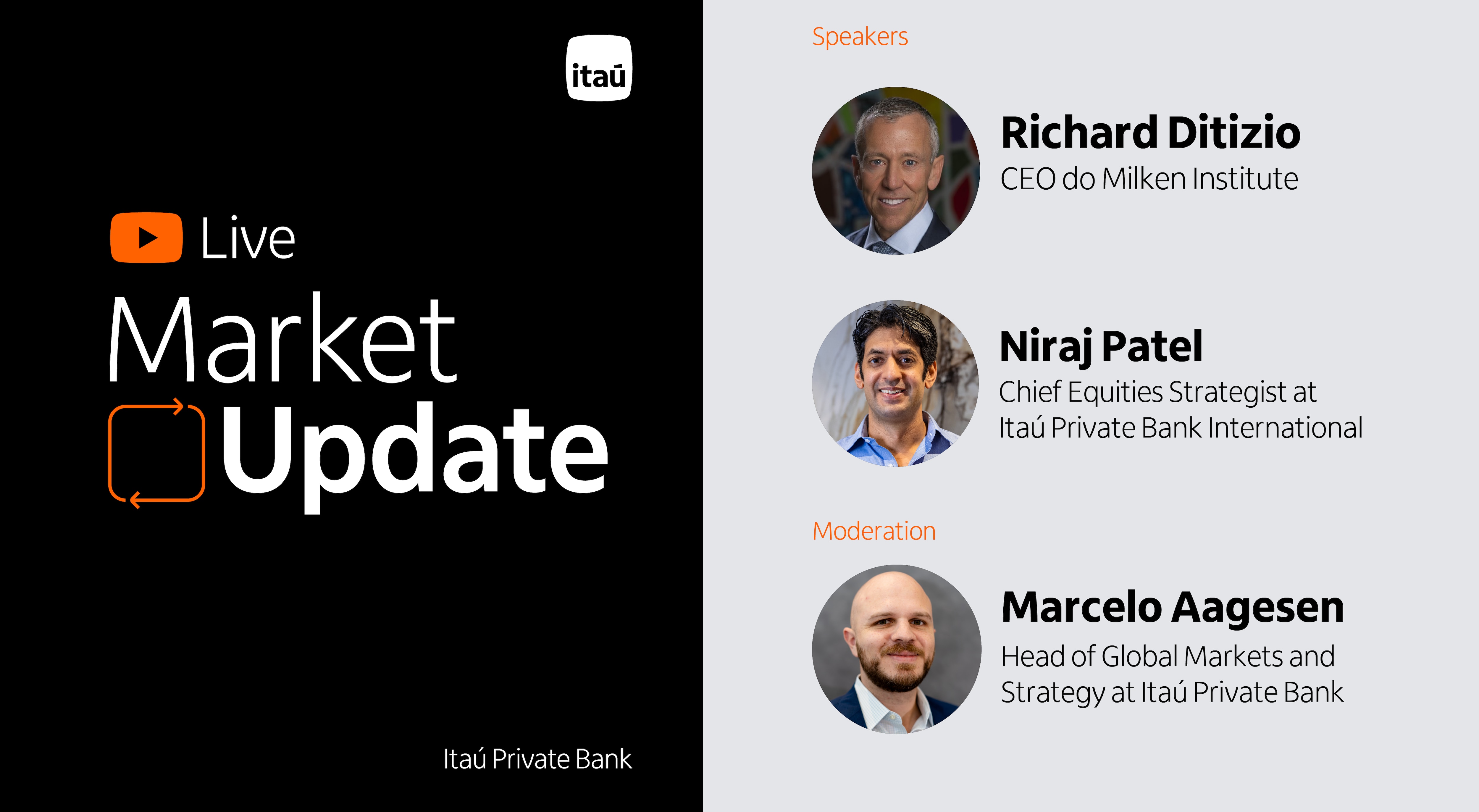
The latest edition of the monthly Market Update live took place on Monday, the 20th. Participants included Richard Ditizio, CEO of the Milken Institute, Laura Deal Lacey, Executive Vice President of the Milken Institute, Vinícius Lummertz, former Minister of Tourism in Brazil and fellow of the Institute, and Niraj Patel, Chief Equities Strategist at Itaú Private Bank International. The session was moderated by Marcelo Aagesen, Head of Global Markets and Strategy.
The Milken Institute is a global, non-profit, non-partisan think tank focused on finance, health, and philanthropy. Recently, the Milken Institute Global Conference 2024 took place, delving into the theme "Shaping a Shared Future." The event featured Elon Musk, Bill Clinton, and other global leaders and addressed topics such as disruptive technology, global economy, advances in biomedicine, sustainability, and inclusive capitalism.
Find below the highlights of the event:
Technology and Social Media as a Catalyst
One of the points discussed at the event was the impact of technology and social media on human capital. In an effort to understand the meaning of work for the new generation, participants recognized, for example, that young people feel the need to work in corporations that share their personal values. This movement is facilitated by social media, which allows closer tracking of companies' cultures.
At the same time, social media amplifies the perception of social inequality. This not only fosters political conflict, but also has negative implications for the mental health of the population, as seen in the rising cases of depression. Thus, the impacts of technology and social media go beyond online, directly reverberating in the markets and in the daily lives of the population.
Rise of the Private Equity Market
Regarding the future of the markets, Ditizio emphasized the optimistic tone of the conference. Besides a historical series of positive returns for American stocks, the fact that the anticipated recession has not yet occurred also encourages this perception.
The conference also focused on the rise of the private equity market and the decrease in options in the public markets. The expansion of private equity creates a new market, more time sensitive, where it is possible to sell a company without a public offering or open capital.
Perspectives on Artificial Intelligence
Artificial intelligence raised mixed opinions. Even with the advent of generative AI, some developers point out that artificial intelligence is not mature enough and there is still many improvements to be made. Investors, on the other hand, expressed concerns about market saturation and a lack of clarity in the long-term monetization strategy.
Overall Outlook on Current Demographics
The conference also explored the importance of understanding how populations, both young and old, are distributed around the globe. The conclusion is that the largest mass of young people today comes from economically disadvantaged parts of the world, with immature capital markets and some type of dysfunction or geopolitical instability. Considering this scenario, it is necessary to figure out what will happen if this new mass is not integrated into the global market or does not have access to the technology ecosystem.
From the investors' perspective, understanding this demographic scenario and the historical and political factors influencing it was pointed out as essential to geographically identify shortcuts to potential investment returns.
Brazilian Participation in the Event
Takeaways
• Technology and social media have been determining factors that influence the population's relationship with the job market and their perception of social inequality.
• The private equity market has grown while options in the public markets have decreased.
• The conference addressed the importance of global demographic distribution, highlighting the challenges and potential impacts of a young mass in economically disadvantaged regions and the need to integrate these populations into the global and technological markets.
• Brazil has great potential as a recipient for direct investments, especially in sectors like clean energy, health, agribusiness, and tourism.
For more details, watch the full live session: